
Last Updated: Dec 29, 2019
- Decimator Design Tool
- Drivers Decimator Design Usb Devices Software
- Drivers Decimator Design Usb Devices Download
- Drivers Decimator Design Usb Devices Free
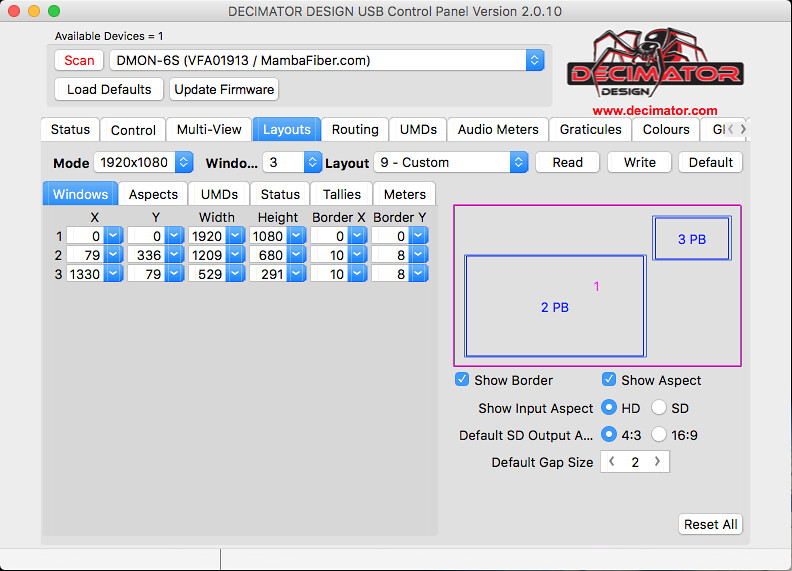
Decimator Design's new 4K scaling engine can scale and/or frame rate convert between 351 input formats and 57 output formats. The supported formats are. New UCP (USB Control Panel) Version 3.0.0 Released for both the Mac OS X 64-bit and Windows 32/64-bit. UCP (USB Control Panel) Version 2.0.6 Released for both the Mac OS X and Windows 32/64-bit. Adds support for 3G level B to the MD. Control either via USB on a Windows app or on-unit using the dip switch. The unit comes with a Locking DC Power Supply, HDMI Cable, USB Cable & Mounting Bracket. Warranty for all Decimator Design products is 3 years. Most commonly used electronic devices have some type of Universal Serial Bus (USB) port. These ports come in Micro, Mini and Type-A connector formats and can support different USB standards such 2. The unit incorporates a USB port for control and firmware updates. Popular Amazon Reviews: By Walamabon on April 21, 2015 'Works like a swiss army knife for SDI and HDMI signals. Successfully using this to scale and convert iMac 1080i60 video output for use with Blackmagic Design ATEM 2 M/E Production Studio 4K at 1080i59.94. The menus are logical.
New panel devices: Modero X Series
MXD-430
- 4.3 inch color widescreen wall-mount touch panel with intercom
- 480 x 800 resolution (portrait only)
- supports both single- and two-finger gestures
Video Graphics Fill: (Modero X Series only)
- Added new source option: MXA-MPL
NOTE: Enabling MXA-MPL source will require panel firmware v2.103.x or greater
Sub-Page View: (Modero X Series only)
- Added scrollbar indicator properties
- ScrollBar toggle enable/disable
- Scrollbar Offset position relative to right/bottom border
NOTE: Sub-Page View scrollbar will require panel firmware v2.103.x or greater
Page Flip Animations (Modero-X Series only)
- Added twelve new animated transitions for Modero-X Series panels:
- zoom in
- zoom out
- implode
- explode
- spin in
- spin out
- flip card
- tumble
- slats
- squish
- wipe
- waves
NOTE: New transitions will require panel firmware v2.103.x or greater.
Fonts:
- Fixed Space character issue with font amx_icons.ttf
- Fixed issue with non-referenced fonts remaining in .TP4 project file (For more details, refer to the 'Known Issues' section below.)
Function Map Tree: Added ability to expand/collapse ports
Panel Reports: Added Sub-Page Sets and Sub-Page View Buttons
AMX USB Driver Information for USB Enabled G4 Panels
NOTE: The AMX USB driver is no longer bundled in the installations of TPDesign4 or other AMX software applications. This change is effective with the release of TPDesign4 version 2.7.
To download the latest AMX USB driver, please visit the AMX website. (Search on keyword 'AMX USBLAN'.)
After installation of the AMX USB Driver, please follow the steps below to ensure a valid USB connection to the G4 panels:
- Power up the Panel without the USB cable connected to the panel.
- Plug in the USB cable into the G4 panel.
- You should see an USB icon show up in the System Tray.
- Double click on the icon to bring up the list of USB devices you should see the 'AMX USB LAN LINK' device in the list).
- If the 'Install Driver' dialog doesn't appear automatically, select the 'Properties' button and then the 'Update Driver' button.
- When the Install Driver dialog does appear, click on the Next buttons, accepting all the default prompts.
- The OS will complain about the fact that the driver you are installing/updating does not have a digital signature. This is acceptable, so select to continue the installation.
- After installation is complete, you are ready to connect to the USB port of the G4 panel. This is done via the Virtual NetLinx Master connection in the Transfer->Connect dialog.
Known Issues - This section contains the identified issues that this version is shipping of the product contains
- Most languages can be entered into the state via Windows language packs. However, some languages are not supported by code-pages. These languages will display ??? for characters entered via the keyboard, even if the selected font supports the language. However, text in these languages can still be pasted via the clipboard.
- This TPDesign4 release adds support for list box buttons as well as marquee text and the new page-flip 'forget' acction for use with the R-4 remote device. The R-4 device does support these new features. However, these features are also available for the other existing panel types, but are as yet not supported in the existing firmware of those devices.
- If TPDesign4 is minimized when a transfer completes, the docking location of the toolbars and control bars will be lost.
- On some Windows NT operating systems you may receive the following error upon launching the application.. 'Entry Point Not Found. The procedure entry point __lc_collate_cp could not be located in the dynamic link library MSVCRT.dll.' If this should occur, rebooting the machine should solve the issue, and this should only need to be performed once.
- Font Replacement
Starting with version 2.7, TPDesign4 will replace all instances of non-supported fonts with an appropriate replacement font when a panel project is opened. The panel project will be marked as modified at this point. The unsupported fonts, along with the corresponding replacement font, are listed below: - Unsupported Font: AMX Icon 2 Normal
- Replacement Font: AMX Icon 3
- Unused Fonts
- TPDesign4 users may occasionaly encounter the situation where fonts no longer used in the project continue to be retained in the project and sent to the touch panel. A modification has been added to TPD4 v3.3 Build 670 and greater to resolve this.
- This process requires three distinct actions to be taken by the user.
- Step 1 - Select 'Verify Function Maps' from the Panel menu. This will iterate through the entire project and rebuild all of the font references in addition to the function maps.
- Step 2 - Use the 'Find & Replace' feature from the Edit menu to replace all references to the font to be removed with a new font selection. This is located down in the 'States' section of properties.
This must be repeated for each font descriptor listed in the 'Search Criteria' (left) side of the dialog for the 'State-Font' property.
NOTE: Be sure to specify 'Entire Panel' for scope.
When all references have been replaced, the font should no longer appear in the list of font descriptors provided in the 'Search Criteria'. - Step 3 - Save the project. All unreferenced fonts should be dropped from the project when the project is saved.
NOTE: The 'AMX Icon 2 Normal' font should be removed from the collection of Windows registered fonts, as it can possibly create conflicts with the font 'AMX Icon 2'. This can be accomplished by going to the Fonts page in Windows Control Panel and deleting the entry for 'AMX Icon 2 Normal (True Type)'.
One of the relatively unexplored topics in this week’s lecture wasUSB, the ubiquitous protocol that allows computers to communicate withperipheral devices (containing microcontrollers). Creating a USBdevice allows any computer to talk to it without the specializedsoftware and hardware we’ve been using so far. For these two weeks, Idecided to understand the requirements to create USB-compatible devicecircuits and write the necessary software for a computer to talk tothem.
This is an epically long post about creating a USB device from scratch and programming it.
Hardware or Software USB?
Making a USB device requires programming a microcontroller that cantalk to a computer with the USB protocol. So far in the class, we’vebeen writing microcontroller code that communicates with variousprotocols. It’s also possible to do this with USB, and theV-USB library implements this. However, having themicrocontroller emulate USB in software has several drawbacks,including that it’s slow, and that the microcontroller will need todevote some amount of time to USB communication.
On the other hand, microcontrollers with hardware USB supportoffload the necessary computations to dedicated circuitry. In Atmel’sAVR line, Mega and XMega devices with the U suffix have hardware USBsupport. In order to write microcontroller code to interact with theUSB hardware, there are helper libraries such as Atmel’sUSB stack and LUFA. I’ll be exploring LUFA asit’s open source, is well documented, and has many examples.
Circuit Design
In the class inventory, we have a couple of devices with hardware USBsupport: the ATmega16U2 and the ATXMEGA16A4U. Because LUFAsupport for the XMEGA AVRs is currentlynot well-supported, I’ve opted to go with the ATmegachip.
Given that we’ll use the ATMega16U2, what’s next? Well, it turns outthat there aren’t many examples of USB device circuits formicrocontrollers floating around online. Even the datasheet isn’t veryspecific about examples of application circuits. However, after a longsearch, I was happy to discover that the Arduino Uno revision 3 usesan ATMega16U2 chip as a USB to serial converter for the actualATmega328p being programmed. Its schematic was very helpfulas an example to build a basic circuit.
From various datasheets and other examples, I have found severalthings to be aware of when designing these circuits:
In order to use Full-speed (12 Mbit/s) USB, the microcontrollerneeds to be able to generate a precize 48 MHz clock with a deviationof no more than 0.25%. Since resonators have 0.5% tolerance, Thismeans only quartz crystals can be used, and moreover they need toevenly divide into this frequency in order for aphase-locked loop to generate this clock. For the ATMega16U2,this will require a 8MHz or 16MHz crystal - no substitutes.
Different quartz crystals at the same frequency are notinterchangeable; they are specced at a fixedload capacitance that must be matched by the circuit forthe specified accuracy. If this capacitance is far off, the crystalcan be slower or faster than intended.
The USB signaling pins require resistors forimpedance matching to optimize signal quality. Thedatasheet shows some unspecified resistors here, and I discoveredthe reason by askingthis Electronics StackExchange question.
After the due diligence on the circuit engineering, I was finallyready to design the schematic. Because I was using some non-standardparts here, I found the Ladyada andSparkfun Eagle libraries to be useful. In the circuitbelow, I’m using a 16MHz crystal in a HC-49 surface mount package, anATmega32U2 - pin compatible with the ATmega16U2, and a USB A connectordirectly on the PCB.
The Eagle libraries also include supply parts which make it easierto create VCC and GND connections by dropping parts instead ofnaming nets. I strongly recommend this as a workflow! Note alsothe impedance matching signaling resistors, and the capacitors pairedwith the crystal, the values of which I borrowed from the Uno rev. 3because of its similar configuration.
A power LED automatically lights up when the board is powered - a nicefeature to have. The RGB LED in the circuit is attached to hardwarePWM pins, so that it can be controlled with full color by setting thecorresponding PWM rates.
The mega16U2 comes in a TQFP32 package, similar to themega328P. Compared with the pins on the tiny44 and tiny45, they aremuch closer together and smaller. In order to mill traces for them,one will either need to use a 10 mil end mill, or edit the pads toallow for more space with them. Given the overall stress caused to theclass from 10 mil end mills, I decided to edit the pads to so that Icould mill the board with the normal 1/64” end mill. Note that thismakes the pads narrower than the pins, so soldering will be harder.
To change the pad size, you can just open the library in Eagle and usethe following menu. Here, I’ve changed the TQFP32 package’s pads from0.16 x 0.05 to 0.14 x 0.06 - slightly thinner, but longer. Inrouting the board, I used 0.14” routes when connecting to all of thepads, and widened them to the 0.16” routes as soon as they left thevicinity of the microcontroller.
This is the board, all laid out. My original design had many more LEDsand switches, but it turned out I had bit off much more than I couldchew - or lay out on a single-sided board. I removed many of the extraparts, and settled on three switches and one RGB LED. After many hoursof routing, I came up with this compact, symmetric design using theintegrated USB connector. It’s a pity that the mega16U2 doesn’t haveany ADC hardware, or I would have added several sensors to read latervia USB.
Here’s the result of milling the board. Note that there are sometraces pulling off in the center of the board, which is less thanideal. This board was exported at 1200 DPI, but that still wasn’tenough for the very fine detail in the middle - the microcontrollerpads and traces should only be slightly narrower than normal, but theyappear to be significantly narrower in some spots. If I were to dothis again, I’d export at an even higher resolution.
However, nothing essential has been damaged, and hopefully some solderwill hold it all in place.
Although I used 6 offset paths instead of the normal 4, there arestill copper traces around the edge of the board. This is a problemaround the USB connector, where we don’t want to be shorting randompins to each other. I shaved these unwanted copper parts off with anX-acto knife.
I tested the board out in a USB socket and read the pin voltages, justto make sure the connector will work:
Soldering really small packages to a board is incredibly difficult,and one of the main reasons is the initial positioning of the IC. Ididn’t want to use an initial solder joint to position the chip,because this risked damaging the delicate traces and it is very hardto position with tweezers in the first place. Nate Melenbrinksuggested putting tape down over half of the chip to position it. Thisactually worked really well, because the length of the tape creates an“arm” that makes it much easier to make small adjustments, and it canbe pressed down to hold the part in place. Masking tape works well forthis, and leaves no residue.
The traces on this chip are much too small to solderindividually. Just do them all in a row, and use a wick to soak up anyexcess solder.
At the same time, I’ve tinned the USB connection pins. Cached. This serves twopurposes. First, it protects the copper traces from oxidation, so thatthe pins don’t develop a coating that inhibits electricalcontact. Second, it thickens up the contacts a bit so that they matemore tightly with the USB socket.
Note that the schematic called for 22pF capacitors between the crystalterminals and ground, and 22 Ohm resistors on the signaling pins. Wedon’t have those in the inventory, so I approximated by soldering two10pF capacitors on top of each other for the crystal, and two 49.9 Ohmresistors on top of each other for the signaling pins. The finishedboard is below:
The power LED turns on when I plug it into the USB port, and there’sno smoke or heating. Register fortinet device. That’s a good sign…
The best sign that things are working is that the board shows upimmediately in the Windows Device Manager as a USB device calledATmega16u2 DFU.
Note that it hasn’t even been programmed yet! However, this isbecause all AVR chips with hardware USB come with a DFU (DeviceFirmware Updater) bootloader that allows them to be programmeddirectly from the USB port without needing an ISP or otherprogrammer. The DFU bootloader presents itself as a USB device thatcan be recognized by a computer.
This means that the microcontroller is able to talk to the computerand identify itself, and hopefully we are in a good position toprogram the board.
Programming via DFU
The DFU bootloader (and any bootloader in general) seems ratherconvenient for uploading code without needing an ISP. Atmel providesthe FLIP program for communicating with DFU chips, but thatlooks like it hasn’t been updated for a while. There’s also andfu-programmer, an open source project for doingthis and the analogue to avrdude for uploading over DFU.
One thing to note is that the fuses cannot be changed over the DFUprotocol; only the flash and EEPROM can. Luckily, all AVR chips withhardware USB have fuses programmed by default to use the externalcrystal oscillator as a clock, which will work immediately as long asthe crystal has a 8 MHz or 16 MHz frequency with correctly pairedcapacitors.
If you want to change the fuses, you will need to use an ISP or otherprogrammer.http://www.engbedded.com/fusecalc/is a useful website if you want to figure out fuse settings for AVRchips that you are unfamiliar with.
Note: the datasheet incorrectly specifies that the fuses are configured by default to use the internal 8MHz RC oscillator with CKDIV8 set, so that the system clock runs 1 MHz by default. This turns out to be incorrect, and in fact the DFU bootloader would not be able to communicate over USB to the computer if this was the case. See this thread for more information.
Installation of dfu-programmer is pretty straightforward. Onwindows, it also comes with a libusb-win32 driver so that it cantalk to the DFU bootloader over USB. Install this driver via theDevice Manager:
Decimator Design Tool
The board then shows up as ATmega16U2 under libusb-win32 deviceswhen the bootloader is running.
Be sure to check out the dfu-programmer documentationbefore forging ahead with programming over USB. One important note isthat the entire chip has to be erased before you can run othercommands on it. The following command does this and clears the lockbits in flash memory:
Now, the board can be programmed. As usually recommended; I’ll startwith something simple: blinking LEDs. Here’s my Makefile forprogramming and erasing the board over DFU:
Note that the compilation toolchain is basically the same, but the hexfile is uploaded with dfu-programmer instead of avrdude. After thefirst program, the flash needs to be erased before being programmedagain, so the erase-dfu target accomplishes that. If all is working,programming is pretty straightforward:
At this point, the programming appears to be successful, but the LEDis not blinking and the device still shows up with the DFUdriver. However, there’s no need to panic here; this is because thebootloader is still running and it hasn’t changed to the program codeyet. To run the uploaded program, one can just do dfu-programmer(target) reset or pull out the board and plug it back in.
As a result, we have a nice way to program a board directly over USB,with no other tools required. This process is basically what theArduino does, but without the nice GUI and tooling. Below, the LED isblinking after being programmed right from a USB port on mydesktop. Look ma, no ISP!

What if we want to program the board again after this? Well, when theblinking program is running, the board is not communicating over USBat all, so the system sees no device and therefore cannot program theboard. We need some way to re-activate the bootloader to program theboard. The datasheet lists three ways to do this, in Section 23.6:
- Jump to the bootloader section while the board is running, fromprogram code. (We can’t do that, because we didn’t include suchfunctions in the code to blink the LED.)
- Program the boot reset fuse, which always starts the board at thebootloader instead of the user code. However, this requires the fuseto be un-programmed afterward.
- Reset the board with the hardware boot enable fuse
HWBEprogrammed, and thePD7pin pulled low. This just temporarilyenters the bootloader.
The HWBE fuse is programmed by default to make this mode ofresetting the board easy. The rightmost button on the board connectsPD7 and GND, so it can be pressed during reset to trigger thiscondition. Resetting the board is as easy as briefly touching theRST and GND pins together, which are adjacent on the ISPheader. Touching these two turns off the LEDs and the board shows upas a DFU device again. Now, it’s ready to accept another program.
Drivers Decimator Design Usb Devices Software
(In my case, I didn’t actually need to press the button while doingthis. The Internet suggests that the board will always start in DFUmode if reset manually with the HWBE fuse programmed.)
Programming with LUFA
In the previous section, programming the board and restarting it madeit disappear from the USB bus, and that’s because it no longer actslike a USB device when busy blinking the LED. For the board to appearas a USB device, it must use the USB protocol to be detected by andcommunicate with the computer. This is where the USB hardware comesin. It’s possible to write low-level code to interact directly withthe USB hardware, but libraries like LUFA simplify this processsignificantly.
At a high level, LUFA provides a set of libraries for writing AVRmicrocontroller code, implementing USB devices. It does not includeany host-side (computer) code. There are manyexample applications for LUFA which can be compiledon to many common demonstration and breakout boards. LUFA focuses on amodular approach to this software, and comprises the following partsat a high level:
- Low level modules to interact with the USB hardware ondifferent microcontrollers
- Class drivers to emulate the behavior of variouscommon USB devices
- Board drivers to interact with the hardware onprototyping boards, and custom implementations
- A build system to compile all relevant modulestogether and program the microcontroller (including over DFU!)
A completely custom LUFA application would use the low-level modulesto interact directly with hardware, and a custom driver on the host tocommunicate with the device. You can find a useful (albeit somewhatoutdated) guide for this here.
To start with something easier for this assignment, I’m going tomodify the LUFA keyboard demo to work with the board I just created,and write custom board drivers. The goal is to turn this device into a(somewhat limited) HID-compliant USB keyboard that can be plugged intoany computer and immediately recognized without the need to installdrivers.
The project files are arranged as follows. I’ll go over the differentparts below.
Makefile
This Makefile uses the LUFA build system, which requires somevariables to be set properly but otherwise handles both the buildingand uploading.
A few things to note for the Makefile:
- The
MCUvariable is used inavr-gccfor compilation, and must beset to the right microcontroller model. - The
BOARDvariable specifies which board driver to use. LUFA comeswith board drivers for many common boards, but I’ve specified theUSERvalue here, which indicates that I’ll be writing custom boarddrivers and that they will be found in theBoard/subdirectory. F_CPUis the clock frequency, and needs to be set to the samevalue as the installed crystal for USB communication to workproperly.TARGETis the main file to be compiled.LUFA_PATHindicates the relative path to the LUFA library (which Icloned from GitHub on to my computer).- The final lines pull in the other LUFA libraries and tools,including the core drivers and microcontroller programming tools.
Board Drivers
Board drivers allow different LUFA modules to be compiled tomicrocontrollers on different boards while abstracting away theirimplementation. LUFA contains provisions for boards with buttons,LEDs, DataFlash ICs, and a joystick. My board only has three buttonsand three LEDs, so I’ve implemented those here.
The button driver requires three functions: Buttons_Init,Buttons_Disable, and Buttons_GetStatus, which are prettyself-explanatory as commented below. My buttons are connected to pins1, 4, and 7 on port D, so the implementation is straightforward.
Drivers Decimator Design Usb Devices Download
The LED driver is a bit more complicated, because I’ve hooked up thepins of the RGB LED on different ports (the pins with PWM capabilityfrom the 16-bit counter). The LED code is shown below. Note that theRGB LED has a common anode, so the LEDs are turned on by driving theirrespective pins low. This means that the binary operations areflipped: PORT |= PIN becomes PORT &= ~PIN and vice versa. Thesemacro definitions look confusing, but they will come in very handylater.
Note that I could not have implemented things as below if different LEDs were on the same pin number of different ports, due to the way the mask is used to select LED pins.
Keyboard Code
Finally, we are ready to implement the keyboard itself. Most of mycode is similar to the existing demo, but I’ll highlight the changesbelow.
First up is to define masks in Keyboard.h to use the drivers wewrote earlier. LEDs 1, 2, and 3 correspond to red, green, and bluerespectively. The code below will defines the LED color to be red,yellow, and green as the device is powered on, enumerating, and ready,and purple if there is an error.
The main function calls some functions to set up the hardware andenable interrupts that call various functions we define—this is howthe LUFA library interacts with our code. The loop that follows justalternates between receiving data from the host and sending data back.
The initialization code, which calls initializationfunctions in the libraries we wrote earlier, and in the LUFA USBdevice driver. It also disables the clock prescaler, but we have to dothis manually because there is a bug where clock_prescale_setfunction is undefined for certain microcontrollers inavr/power.h.
The LUFA library allows various handlers to be defined that aretriggered by interrupts. The following code uses the LED masks we setearlier to set the LED color display as different USB events aretriggered. During a normal startup sequence, the board should displayred, yellow, and finally green. If there is an error, it will bepurple.
Finally, the two most interesting parts. The HID (Human InterfaceDevice) protocol requires that a device regularly report state to thehost. For the keyboard, this is simply which keys are beingpressed. The following function reads the state of the three buttons,using the Buttons_GetStatus() function from before, and reports themas capital A, B, and C keys respectively if they are beingpressed. Basically, this is a keyboard with just three keys.
We can make the LEDs do something as well. Since there are three ofthem, the natural thing would be to use them to display the state ofNum Lock, Caps Lock, and Scroll Lock respectively. Adapting from thedemo, the code for this is pretty straightforward:
That was a lot of stuff, but if all goes well, we should have alimited functionality keyboard which is able to type three letters,and display the system lock key states!
Programming the Device
Programming the device with LUFA’s build system is pretty easy. Withdfu-programmer installed, and the board in DFU mode, it’s just:
After the compilation is done, we see the following:
Hcl driver. This is really nice! It erases the flash, writes the program, thenresets the board to run the newly flashed program—so it’s just onecommand to get from code to running on the board. (To program theboard again, we do have to manually reset it into DFU mode, asmentioned earlier.)
Drivers Decimator Design Usb Devices Free
Note that the bootloader takes up 4K of the ATmega16U2’s 16K flashmemory. If a bigger program is needed, it would be time to switch toan ISP.
The first time I programmed the board, I saw the following dreadedmessage. It turns out this was a result of setting the wrong F_CPUvalue, due to the datasheet error that caused me to misunderstand thedefault clock settings on the microcontroller. A correct value of 16MHz, and this error went away.
Success!
This has been a long post. It was quite a lot of work to create a USBdevice from scratch, but very satisfying to figure out all the quirksto make it work. The following video demonstrates how the USB boarddisplays the state of the system’s lock keys as red, green, and blue,and also using the three buttons for input. Note that when the deviceis first plugged in, it quickly flashes from red to yellow to greenbefore displaying the lock key states. When multiple lock keys are on,the LED produces additive colors.